
Complexity, Accuracy, and Fluency (CAF)
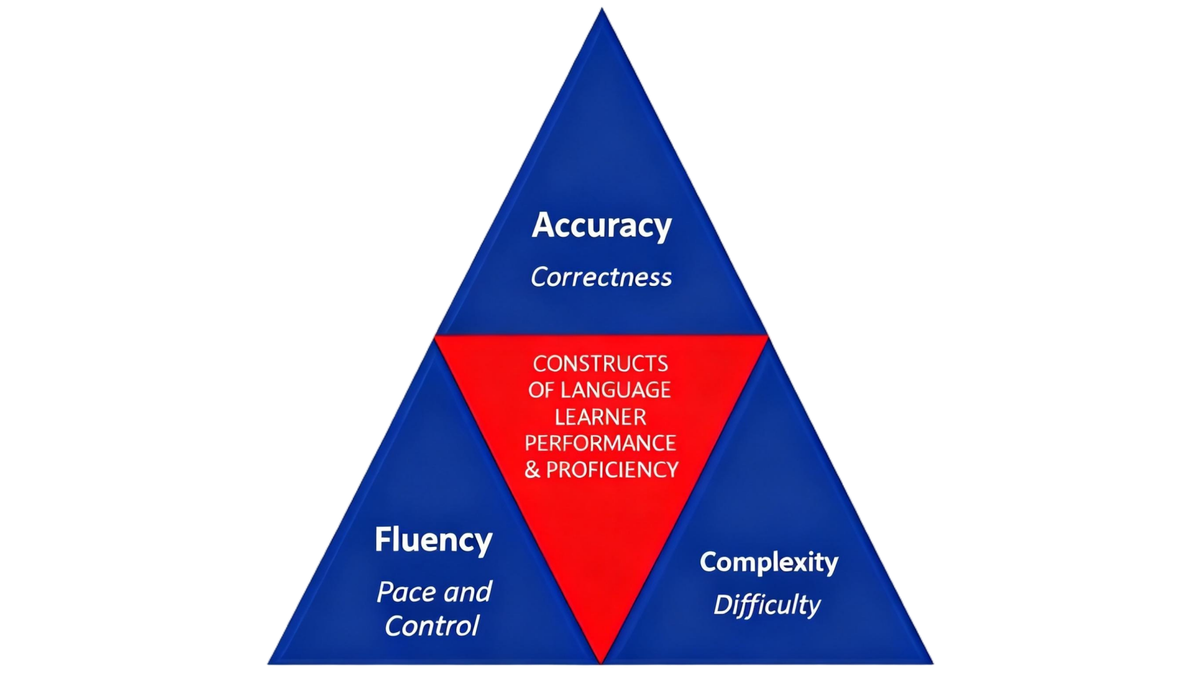
The Complexity, Accuracy, and Fluency (CAF) triad has emerged as a robust framework in Second Language Acquisition (SLA) research for assessing language proficiency. This multidimensional framework captures the dynamic nature of language production and development. The genesis and evolution of CAF are rooted in exploring the very essence of language ability, while its definitions, measurements, and the intricate interrelationships between the three dimensions form a critical foundation for both SLA theory and pedagogical practice.
复杂性、准确性与流利性(CAF)作为三元评估框架,已在第二语言习得研究中成为衡量语言能力的核心指标。这一多维框架不仅反映了语言产出的动态特性,还揭示了语言发展的过程。CAF的提出与发展源于对语言能力本质的深入探索,而其定义、测量方式及三个维度之间复杂的相互关系,构成了二语习得理论教学实践的重要基础。
Origin, Development, and Significance
The evolution of the CAF framework can be traced back to early SLA research that distinguished between fluency-driven and accuracy-driven tasks. The former emphasized spontaneity and communicative efficiency, while the latter focused on grammatical correctness and controlled output. In the 1990s, Skehan's proposal of a holistic model integrating complexity, accuracy, and fluency formally established complexity as a key dimension for evaluating second language ability. Since then, CAF has become a crucial indicator of learner performance and developmental progress.
CAF框架的演变可追溯至早期第二语言研究中对流利度驱动任务与准确性驱动任务的区分。前者强调语言产出的自发性和交际效率,后者则注重语法的正确性和形式的可控性。1990年代,随着Skehan提出整合复杂性、准确性和流利性的整体模型,复杂性正式成为评估第二语言能力的关键维度。此后,CAF逐渐被视为衡量学习者语言表现和发展的重要标志。
The cognitive turn in mid-1990s SLA research positioned CAF at the forefront of scholarly inquiry. Substantial theoretical and empirical studies have confirmed the pivotal role of CAF in describing second language behavior and competence. Factor analyses, for instance, have demonstrated that CAF constitutes the core components of second language behavior, underscoring the importance of considering all three dimensions simultaneously when investigating learner proficiency. CAF not only reflects learners' immediate language performance but also reveals potential changes in the underlying second language system, holding significant value for language teaching, assessment, and developmental research.
1990年代中期的第二语言研究经历了认知转向,CAF逐渐成为研究的核心议题。大量的理论和实证研究证实了CAF在描述第二语言行为和能力中的关键作用。例如,因子分析表明,CAF构成了第二语言行为和能力的核心组成部分,强调了在研究学习者语言能力时综合考虑这三个维度的重要性。CAF不仅反映了学习者即时的语言表现,还揭示了第二语言系统的潜在变化,因此在语言教学、评估及发展研究中具有重要价值。
Definition and Measurement
Accuracy is the most clearly defined dimension within CAF and remains the primary focus for many educators. It measures the extent to which a learner's language use deviates from established target language norms, encompassing everything from grammatical correctness to pronunciation standards and appropriate word usage. As commonly seen in teaching practice, whether it's correcting a sentence like "I play skiing," distinguishing between names like "John" or "George" in a listening exercise, or accurately comprehending the meaning of a reading sentence like "The problem is anything but easy" (meaning the problem is not simple at all), all exemplify the paramount importance placed on accuracy. These deviations are typically identified as "errors," thus accuracy is often understood as the ability to produce error-free language. While there is consensus on its definition, measurement methods vary. For example, Ellis and Barkhuizen proposed assessing accuracy by calculating the proportion of error-free clauses and the frequency of errors per 100 words. Larsen-Freeman suggested using the percentage of error-free T-units. In writing research, the Error-free T-unit ratio (EFT/T) has proven to be a commonly used and highly correlated measure of accuracy.
准确性是CAF中定义最为明确、也是所有教师关注的核心维度。它衡量学习者语言使用与目标语标准之间的偏离程度,涵盖了从语法结构是否正确到单词发音是否标准、使用是否恰当等方方面面。正如教学实践中所见,无论是句子改错题“I play skiing”的判断,听力中辨别人名“John”还是“George”的细节,还是理解阅读句子“The problem is anything but easy”(这个问题绝不简单)的准确含义,都体现了对准确性的极致追求。这些偏离通常被视为“错误”,因此准确性常被理解为无错误语言产出的能力。尽管在定义上存在共识,但其测量方法多样。例如,Ellis和Barkhuizen提出通过计算无错误子句的比例和每100个单词的错误频率来评估准确性;Larsen-Freeman则建议使用无错误T单位的百分比。在写作研究中,无错误T单位比率(EFT/T)被证明是与准确性高度相关的常用指标。
Complexity is the most intricate and challenging dimension to define within CAF, directly linked to language difficulty and sophistication. In domestic English proficiency tests in China, from high school entrance exams to TEM-8 and postgraduate admissions tests, complexity is a key assessment area. It comprises two aspects: cognitive complexity and linguistic complexity. Cognitive Complexity refers to the depth of content and the elevation of ideas, such as whether the theme of an essay is "elevated" or "sublime." Linguistic Complexity is manifested in sentence length, structural intricacy (e.g., use of inversion, subjunctive mood), and vocabulary difficulty and diversity (e.g., use of "big words," "long words," or low-frequency words). In writing, high complexity is crucial for achieving high scores; in reading and listening, test designers often increase complexity to enhance item difficulty and discrimination. In academic measurement, a common index for syntactic complexity is the Clause per T-unit ratio (C/T). A T-unit is defined as "one main clause plus any subordinate clauses or non-clausal structures attached to or embedded within it." It represents the minimal terminable grammatical unit of a complete sentence and effectively measures the syntactic maturity of language output.
复杂性是CAF中最复杂且最难以界定的维度,它直接关联到语言的难度与深度。在国内的英文考试中,从中考到专八、考研,复杂性都是重点考察项。它包含认知复杂度和语言复杂度两个方面:认知复杂度指内容的深度与思想的高度,如文章主题是否有“拔高”或“升华”;语言复杂度则体现在句子的长度、句式结构的复杂程度(如是否使用倒装、虚拟语气等),以及词汇的难度与多样性(如是否使用“大词”、“长词”或低频词)。在写作中,高复杂性是取得高分的关键;在阅读和听力中,出题者也常通过增加复杂性来提升题目的难度和区分度。在学术测量上,句法复杂性的常用指标是子句与T单位之比(C/T)。其中,T单位被定义为“一个主句加上任何附加于或嵌入其中的从句或非从句结构”,它是一个完整句子的最小语法单位,能有效衡量语言输出的句法成熟度。
Explanation of the T-unit with Examples
To clarify the measurement of syntactic complexity, it is essential to elaborate on the T-unit and related concepts. As mentioned, a T-unit consists of one main clause and all its attached subordinate clauses and phrases. It is a crucial unit for measuring the syntactic maturity of language output. A clause must contain a subject and a predicate verb. The calculation of the Clause per T-unit ratio (C/T) intuitively demonstrates a writer's ability to embed clauses within simple sentences to construct complex structures. A higher ratio typically indicates greater syntactic complexity. Consider the following examples:
为了更清晰地理解句法复杂性的测量,有必要对T单位及其相关概念进行说明。如前所述,一个T单位是一个主句及其所附带的所有从句和短语结构。它是衡量语言产出句法成熟度的重要单位。子句则必须包含一个主语和一个谓语动词。子句与T单位之比(C/T) 的计算方式,可以直观地展示写作者在简单句基础上嵌入从句、构建复杂句子的能力。比值越高,通常意味着句法复杂性越高。以下通过例句进行说明:
Simple Sentence (1 T-unit, 1 clause)
- Example: The student read the book.
- Analysis: This sentence has only one main clause, thus constituting 1 T-unit containing 1 clause. C/T = 1/1 = 1.
简单句(1个T单位,1个子句)。
例句:The student read the book.分析:此句只有一个主句,因此构成1个T单位,包含1个子句。C/T = 1/1 = 1。
Complex Sentence with Subordinate Clauses (1 T-unit, 3 clauses)
- Example: The student who I met yesterday read the book which was recommended by the professor.
- Analysis: Although lengthy, this sentence has only one main clause ("The student read the book"), with the rest being relative clauses attached to it ("who I met yesterday" and "which was recommended by the professor"). Therefore, it counts as only 1 T-unit but contains 3 clauses (1 main + 2 subordinate). C/T = 3/1 = 3. This ratio is significantly higher than in Example 1, clearly demonstrating greater syntactic complexity.
含从句的复合句(1个T单位,3个子句)
例句:The student who I met yesterday read the book which was recommended by the professor.
分析:此句虽然较长,但只有一个主句(The student read the book),其余部分均为附着于主句的定语从句(who I met yesterday 和 which was recommended by the professor)。因此,它仍然只算作1个T单位,但包含了3个子句(1个主句 + 2个从句)。C/T = 3/1 = 3。这个比值远高于例1,清晰地展示了更高的句法复杂性。
Two Independent Sentences joined by a Coordinating Conjunction (2 T-units, 2 clauses)
- Example: The student read the book, and he wrote a report.
- Analysis: This sentence joins two independent main clauses with the coordinating conjunction "and," each capable of standing alone as a sentence. Thus, it counts as 2 T-units, each containing 1 clause. C/T = 2/2 = 1.
由并列连词连接的两个独立句子(2个T单位,2个子句)
例句:The student read the book, and he wrote a report.
分析:此句由并列连词“and”连接了两个独立的主句,每个主句都能独立成句,因此算作2个T单位,每个T单位包含1个子句。C/T = 2/2 = 1。
These examples show that the C/T ratio effectively excludes mere coordination of simple sentences, focusing instead on measuring the ability to grammatically elaborate and embed structures around a core main clause, thereby providing a more precise reflection of syntactic complexity.
通过以上例子可以看出,C/T比值有效地排除了简单句并列的情况,专注于衡量在一个核心主句上进行语法拓展和嵌套的能力,从而更精确地反映了语言的句法复杂性。
For lexical complexity, the focus has primarily been on lexical diversity, with less emphasis on lexical density and sophistication. The Type-Token Ratio (TTR) is a widely used measure for lexical diversity, calculated by dividing the number of unique word forms (types) by the total number of words (tokens). A TTR closer to 1 indicates greater lexical richness. However, researchers have noted TTR's unreliability due to its high sensitivity to text length. Consequently, new methods like the Moving Average Type-Token Ratio (MATTR) have been proposed to enhance the reliability of lexical diversity measurement.
词汇复杂性则主要关注词汇多样性,而对词汇密度和复杂度的测量相对较少。在词汇多样性的评估中,类符形符比(TTR)是一种广泛使用的度量标准,通过将唯一词形(类符)的总数除以词形(形符)的总数来计算。TTR越接近1,表示词汇丰富度越高。然而,一些研究人员指出TTR的不可靠性,因为它极易受到文本长度的影响。因此,新的方法如移动平均类符形符比(MATTR)被提出来,以增强词汇多样性测量的可靠性。
Fluency is a dimension often prioritized less in domestic exams but highly valued in international testing contexts. It was first prominently introduced by Brumfit in the 1980s, who defined it as: "Fluency is essentially how fast a learner can access and use the language in a well-paced smooth manner without awkward pauses." This concept applies across skills: in reading, the ability to proceed smoothly without frequent regression or confusion; in listening, the capacity to comprehend rapid speech without becoming flustered; in speaking, the ability to express oneself fluidly without halting or excessive fillers (e.g., "um," "ah"); and in writing, the facility to write fluently rather than pausing frequently to think. Fluency serves as a key gauge of language automaticity and communicative efficiency.
流利性是国内考试要求相对较低,而国外考试高度重视的维度。它由Brumfit于上世纪80年代率先提出,其核心定义是:“流利度本质上指的是学习者能够以良好、平稳的节奏顺畅地提取和使用语言,而不出现尴尬的停顿。” 这一定义体现在各项技能中:阅读时能否一气呵成,无需频繁回读;听力时能否跟上快速语料,不会因语速加快而慌乱;口语时能否流畅表达,避免结巴和填充词(如“嗯”、“啊”);写作时能否文思流畅,而非边想边写、屡屡停顿。流利度是衡量语言自动化程度和交际效率的重要标尺。
Interrelationships within CAF
The dynamic interplay among the three CAF dimensions is a major focus in SLA research. Scholars generally agree that due to learners' limited attentional capacity and cognitive resources, a competitive relationship often exists between complexity, accuracy, and fluency. Skehan's Trade-off Hypothesis posits that learners often must make trade-offs, prioritizing one dimension at the expense of the others. For instance, in task-based language teaching, learners might enhance the complexity or accuracy of their output under attentional constraints but struggle to improve both simultaneously.
CAF三个维度之间的动态相互作用是SLA研究的重要议题。学者们普遍认为,由于学习者有限的注意容量和认知资源,复杂性、准确性和流利性之间存在竞争关系。Skehan的权衡假说指出,学习者往往需要在三者之间做出权衡,优先发展某一维度而牺牲其他维度。例如,在任务型语言教学中,学习者可能因注意力限制而提高语言产出的复杂性或准确性,但难以同时兼顾两者。
Conversely, Robinson's Cognition Hypothesis offers a different perspective, suggesting that tasks requiring greater cognitive resources can simultaneously promote both complexity and accuracy. This is because such tasks direct learners' attention more strongly to language form, potentially improving accuracy alongside complexity. From this viewpoint, the relationship between CAF is not strictly competitive but can be collaborative, depending on task type and individual learner differences.
然而,Robinson的认知假说提出了不同观点,认为需要更多认知资源的任务可能同时促进复杂性和准确性的提升。这是因为这类任务引导学习者更多地关注语言形式,从而在提高复杂性的同时改善准确性。在这一视角下,CAF之间的关系并非绝对竞争,而是可能因任务类型和学习者个体差异而呈现协作性。
From the lens of Complex Dynamic Systems Theory (CDST), CAF is viewed as three subsystems within the language system, engaging in nonlinear and dynamic interactions. These subsystems may compete or support each other. For instance, progress in one subsystem might foster development in another (supportive growth), while others might involve competition for resources where gains in one lead to declines in another (competitive growth). This principle of "complete interconnectedness" reveals the complex nature of language development, indicating that the relationships between CAF are far from simple linear additions. Language development often follows nonlinear trajectories, and the subcomponents of CAF exhibit unique dynamic developmental paths. Therefore, the three dimensions must be examined as an integrated system to gain true insights into the evolution of language proficiency.
从复杂动态系统理论(CDST)的角度看,CAF被视为语言系统内的三个子系统,它们之间存在着非线性和动态的相互作用。这些子系统可能相互竞争,也可能相互支持。例如,某些子系统的进步可能促进其他子系统的发展(合作性增长),而另一些则可能因资源竞争而此消彼长(竞争性增长)。这种“完全互联性”揭示了语言发展的复杂本质,表明CAF之间的关系远非简单的线性叠加。语言发展常遵循非线性轨迹,CAF的各子成分也表现出独特的动态发展路径,因此必须将三者视为一个整体系统进行考察,才能洞察语言能力的真实演进。
Conclusion
The CAF framework provides a multidimensional toolkit for assessing second language proficiency, illuminating the dynamic processes of language development. The diversity in its definitions and measurements reflects the complexity of language ability, while the competitive and collaborative relationships among the dimensions highlight the nonlinear nature of language acquisition. In teaching practice, understanding the connotations and interactions of CAF helps educators balance teaching objectives, tailoring instruction to the needs and developmental stages of different learners to find the optimal balance between solidifying accuracy, expanding complexity, and enhancing fluency. Future research needs to further explore how CAF manifests across different tasks and learner populations and how they evolve over time. Only by treating CAF as a complex dynamic system can we fully comprehend the developmental trajectories and internal mechanisms of second language proficiency.
CAF作为评估第二语言能力的框架,不仅提供了衡量语言表现的多维指标,还揭示了语言发展的动态过程。其定义和测量方法的多样性反映了语言能力的复杂性,而三者之间的竞争与协作关系则凸显了语言习得的非线性特征。在教学实践中,理解CAF的内涵与互动,有助于教师平衡教学目标,针对不同学生的需求与发展阶段,在夯实准确性基础、拓展复杂性边界与提升流利度水平之间找到最佳平衡点。未来研究需进一步探索CAF在不同任务、不同学习者群体中的表现,以及它们如何随着时间推移而演变。唯有将CAF视为一个复杂动态系统,才能更全面地理解第二语言能力的发展轨迹与内在机制。